• ISSN 2097-1370
  • CN 62-1222/K

Column Album

Digitization of Cultural Heritage
Sort by Default Latest Most read  
Please wait a minute...
  • Select all
    |
  • DING Xiaohong, LUO Yuhao, BO Longwei, YU Tianxiu
    2023, 2(3): 50-65.
    The Library Cave at Mogao has attracted worldwide attention since its discovery in 1900. Explorers and scholars from many different countries came to Dunhuang over the following years in order to acquire the cultural relics and historical documents of the Mogao Caves. The earliest, and in many ways most valuable,pictures of the Mogao Caves were taken by these scholars using cameras that were considered highly advanced at the time. These photos record the condition of the Mogao Caves over a hundred years ago and even include images of murals that no longer exist,and are therefore valuable historical materials for the conservation and research of the artwork in the caves. In order to restore wall paintings that are currently cracked or peeling,this paper attempts to restore the color and contents of the black and white photos of the murals on the north wall of cave 220 taken by Luo Jimei and his wife at Mogao in 1943. Support for this project is provided by massive digital resources collected at Dunhuang over the years,and by cutting-edge computer image processing technology.Based on the practice and results of the above methodology,a detailed set of methods suitable for the virtual restoration of black and white images is also provided. It is hoped that the proposed methodology can provide data support for further research on Chinese cave art in the Dunhuang region.
  • WU Jian
    2022, 1(1): 88-92.

    Following the mission of digital protection of cultural heritages in the new era,this paper positioned the goal of digital protection of cultural heritages for permanent preservation and sustainable inheritance,and reviewed the development,maturity and innovation process of digital protection of Dunhuang Grottoes. It puts forward the research and development concept of digital key technology,which is led by science and technology,digital innovation and permanent preservation. The application concept of digital technology and its data achievements is put forward. The paper puts forward the concept of digital talent training,which includes innovation mechanism,collaboration and talent cultivation. Wish to establish a precious cultural heritage in the high quality digital archives at the same time,into a new development concept,inheriting the past experience,excellent academic,science and technology and art in one fusion,continuing to explore the key technology of digital cultural heritage,rich cultural heritage digital technology system,continually improving art connotation of cultural heritage,to better carry forward the cultural heritage of historical,artistic or scientific value.

  • ZHAO Jiajing, LIU Jiaquan, ZHANG Dexuan, PEI Qiangqiang, LIU Hong
    2022, 1(2): 72-80.

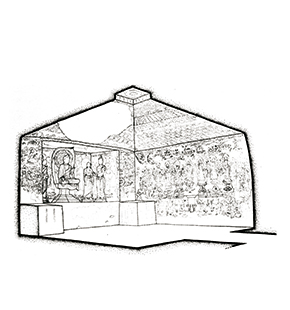
    The stone cultural relics represented by cave temples occupy a very important position in China’s cultural heritage. However,because the protection of such cultural relics is not only related to the cultural relics themselves,but also closely related to their rock mass and surrounding environment,which has become the most complex type of cultural relics protection. In recent ten years,new technologies such as laser scanning and satellite remote sensing have appeared in the protection and reinforcement project of grotto temple,which provides a technical guarantee for the digital and information development of its data acquisition. As a high-precision three-dimensional scanning technology,three-dimensional laser scanning technology is an effective means to realize the digital protection and utilization of grotto temples. By using three-dimensional laser scanning technology,this study takes cave 32 of Beishiku Temple as the research object. After collecting its point cloud data,it makes reasonable use of the point cloud data through modeling and using the point cloud and the model scanning software ReCap,quantifies the diseases of the cave temple by using the point cloud data,and marks and adds information to the diseases in the cave temple,Explore the method of visual management of disease information in grotto temple.

  • TAO Zhigang, CHEN Jiayu , FENG Taibin , WANG Xuan , REN Shulin
    2022, 1(3): 99-112.
    For hundreds of years,under the combined influence of natural stress and human factors,the Yuanjue Cave has been weathered and eroded to varying degrees. As a result,the rock mass structural fissures and unloading fissures around the Yuanjue Cave are extremely developed,which poses a serious threat to the safety of the roof of the Yuanjue Cave. Therefore,it is particularly important to carry out analysis and research on the deformation and stability of the Yuanjue Cave. In this study,firstly the engineering geological conditions,stratigraphic lithology and current roof erosion condition of the Yuanjue Cave are investigated and analyzed;secondly,a high-precision three-dimensional numerical simulation calculation model of the circular tunnel is established by using the three-dimensional laser scanning point cloud modeling method;and finally,the stability analysis of the numerical simulation of the circular tunnel’s roof and site stability monitoring of the most unfavorable position of the roof are carried out to reveal the deformation law of the roof of the Yuanjue cave under the action of self-weight load and pedestrians. The research results provide a new research method for the stability analysis and evaluation of cultural relics protection projects such as cave temples.
  • DING Xiaosheng , WU Jian, YU Tianxiu, LU Yucheng, NIAN Haili
    2023, 2(3): 66-75.
    Controlling errors that result from stretching and deformation with precision when digitizing large-scale curved murals is crucial to ensuring the integrity and reliability of digital resources. This paper presents a case study on the digitization project of the ceiling of Cave 148 in the Mogao Grottoes as an exploration of a highly integrated method of imaging that combines 3D scanning and 2D image stitching technology. This method effectively manages to smooth out issues that occur from image stretching and deformation while maintaining a high degree of accuracy and color fidelity during the process of scanning large-scale curved murals in order to render a 3D model of the mural surface.
  • TONG Yongdong, CAI Youzhen, MA Qinglin
    2022, 1(1): 93-103.

    The 3D modeling method of high fidelity information is an important research content in the digital protection of cultural relics,which is of great significance to the display,research,and restoration. In this paper, a high fidelity information 3D modeling method for cultural relics was proposed based on the Niushi Buddhist monk statue in Lingyan Temple in Shandong Province. Firstly,3D scanning and multi-view 3D reconstruction techniques were used to establish the high precision geometric 3D model and high resolution texture 3D model respectively. Then,the high-resolution texture of the texture model was automatically mapped to the surface of the high precision geometry model through mutual registration and alignment of the two heterogeneous models,and realized the fusion of high precision geometry information and high resolution texture information. Based on mature commercial software and hardware, the cultural relics high fidelity information 3D modeling method proposed in this paper has the advantages of simple operation and low cost,which has practical significance for efficient digital archiving of cultural relics.